
Humanism at the Heart of HFNJ
March 16, 2026
Throughout 2026, we are running a series of articles on the first 30 years of the Foundation’s history and legacy. Read the articles here:
- Article 1: Celebrating 30 Years of History
- Article 2: Lester Lieberman and the Creation of HFNJ
- https://hfnj.org/humanism-at-the-heart-of-hfnj" > Article 3: Humanism at the Heart of HFNJ
Humanism at the Heart of HFNJ
For three decades, The Healthcare Foundation of New Jersey (HFNJ) has advanced the simple but transformative idea that healthcare must treat the whole person, not just the disease. At heart, the idea stems from putting the Jewish precept, b’tzelem Elohim (in God’s image), into action by seeing each person as a unique and valued human being, and not merely a diagnosis.
Since its founding in 1996, this ideal of humanism in medicine has remained the Foundation’s guiding principle.
| What Is Humanism in Medicine?
At HFNJ, humanism in medicine means:
|
HFNJ’s enduring commitment to a humanist approach in medicine stemmed from the vision and experiences of its founder, Lester Lieberman, of blessed memory. As former Chair of Newark Beth Israel Medical Center, Lieberman listened carefully when patients shared their frustrations. Too often, they described physicians as rushed, dismissive of their pain, or lacking empathy. These interactions sparked a guiding conviction: healthcare must be rooted in compassion, empathy, respect, and cultural sensitivity. This belief became foundational to HFNJ’s mission, and humanism in medicine was embedded in the organization’s DNA from the very beginning.
Strategic Grantmaking to Champion Humanism
HFNJ began investing in projects and organizations promoting humanism in medicine upon its founding in 1996. In an early partnership with the Arnold P. Gold Foundation (a foundation whose mission is solely focused on promoting humanism in medicine), HFNJ helped launch and sponsor the signature white coat ceremonies, which have since become a national rite of passage imbuing the precepts of humanism in medicine to all medical professionals. HFNJ sponsored focus groups for medical residents to identify barriers to sustaining humanism during the demanding years of residency. These conversations revealed how widespread burnout, hierarchy, and systemic pressures can erode empathy, and helped shape strategies to counteract them.
That same year, HFNJ launched the Annual Humanism in Medicine Lecture with the Association of American Medical Colleges. The lectures helped to elevate statewide and national conversations about compassion in healthcare education.
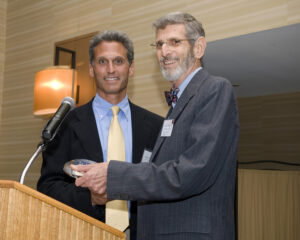
HFNJ Trustee Dr. Adam Perlman presents an HFNJ Humanism Award in 2010.
In 2001, HFNJ established what would become a hallmark of its public face in the community for the next two decades: the annual HFNJ Humanism in Healthcare Awards. Taking the form of an annual dinner, the event honored employees at grantee institutions – including physicians, nurses, social workers, custodians, drivers, and others who demonstrated extraordinary compassion in care. Similarly, the Lester Z. Lieberman Leadership Award was given to leaders at non-profit organizations that embodied the spirit of humanistic care. Each of the 326 individuals who received one of these honors over the years received a monetary award from the Foundation to recognize their contribution to the community. By celebrating these individuals, the Foundation reinforced the message that empathy and compassion are central to any healthcare practice.
In 2003, HFNJ made a landmark investment in the future of medical training. With a $3.2 million grant to Rutgers New Jersey Medical School, the Foundation established The Healthcare Foundation of NJ Center for Humanism and Medicine. The award created both an operational endowment and annual scholarships for incoming students known as Humanism Scholars. By engaging students at the very beginning of their careers, the Center serves as a bulwark against the technocratic and bureaucratic pressures that can diminish empathy over time. It ensures that compassion is not something physicians “rediscover” later—but something they learn and never lose.

Dr. Manasa Ayyal, current Director of the Humanism Center at Rutgers NJ Medical School.
In 2014, HFNJ provided a similar endowment to Newark Beth Israel Medical Center to create the Lester Z. Lieberman Hematology/Oncology Fellowship. The Fellowship was created to honor Lester Z. Lieberman’s lifetime work promoting care and empathy in healthcare settings. The program had a main goal to develop highly skilled physicians who could deliver not only cutting-edge treatment, but deeply compassionate care. Each fellow completes a project demonstrating an aspect of humanism in medicine. The most recently graduated fellow, Dr. Daniel Miles, completed a humanism in medicine project focused on quality of life in sickle cell patients transitioning from pediatrics to adult hematology.
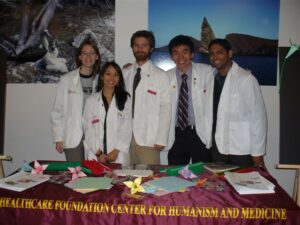 Through programs like the Rutgers Center and the Lieberman Fellowship, HFNJ has created enduring institutions that promote the ideals of humanism long after the initial grant was awarded. Both bring the concept of humanism from the abstract to the actual—informing tangible interactions in exam rooms, medical centers, and bedside conversations.
Thirty Years Later: Legacy of Humanistic Care
Over the past thirty years, HFNJ has:
- Sponsored national conversations about empathy in medical education;
- Recognized frontline healthcare workers who model compassion;
- Endowed transformative training programs to cultivate humanistic physicians; and
- Elevated client-centered care as a professional standard.
Yet humanism is not a relic of the Foundation’s early years. It continues to shape every grant decision. Today, each applicant is asked to describe in their application how their organization and project adhere to the principles of humanism in medicine.
Several of the Foundation’s major investment in recent years focused on creating new programs that provide person-to-person, humanistic care to different populations – including a $294,739 grant to JCC of MetroWest to expand the Littman Family Memory Center to allow it to serve seniors with moderate memory impairment and their caretakers; a $1,000,000 grant to Overlook Medical Center to create the HFNJ Child and Adolescent Behavioral Health Assessment Center; and a $250,000 grant to Newark Beth Israel Medical Center to create a Geriatric Center of Excellence. The Foundation has also launched initiatives that identify gaps in care and take a person-centered approach to solving them. In 2011-2012, the Foundation launched an initiative that awarded more than $800,000 to help area hospitals prevent and treat hospital-acquired-delirium. HFNJ began an initiative in 2024 to provide increased behavioral health supports for Jewish adolescents, which has resulted in more than a million dollars in funding supporting the humanistic delivery of person-centered behavioral health care.
 And humanism is not a value that Foundation only espouses for our grantees. It is a principle which is lived each day at the Foundation. At every staff or board meeting, discussions are conducted with respect and tolerance, even when there may be strong disagreements. Each trustee or staff member’s voice is valued and heard and grant decisions are arrived at by consensus.
For thirty years, The Healthcare Foundation of New Jersey has strategically invested in this broad range of programs to ensure that empathy survives the pressures of modern medicine. In an increasingly complex medical climate where humans are often replaced by machines and decision makers substituted by artificial intelligence and algorithms, the Foundation will continue to hold fast to its commitment ensuring that compassion, dignity, and respect remain central to the delivery of health and human services.